People’s History Museum (PHM) is marking the 90th anniversary of the outbreak of the Spanish Civil War (1936-1939), with a special day of talks, film, music, and archive access exploring the conflict that exposed the growing threat of fascism and inspired an extraordinary international response by ordinary people.
The Spanish Civil War is one of the stories shared in the galleries at the national museum of democracy. On Saturday 11 July, a commemorative event will investigate the experiences of the many thousands of people from Britain who supported the Spanish Republic through military service, fundraising campaigns and humanitarian aid. Using objects, photographs, and personal testimonies from PHM’s collection, the event will examine how people responded when democracy came under threat.
The Spanish Civil War broke out in July 1936 when leading army officers including General Francisco Franco attempted a military coup against the recently elected Republican government. Franco’s forces were supported by Nazi Germany and Fascist Italy, heightening fears about the spread of fascism across Europe. Although the British government maintained a policy of non-intervention, thousands of volunteers and supporters from Britain joined an unofficial international movement (of more than 50 countries) to defend the Spanish Republic.
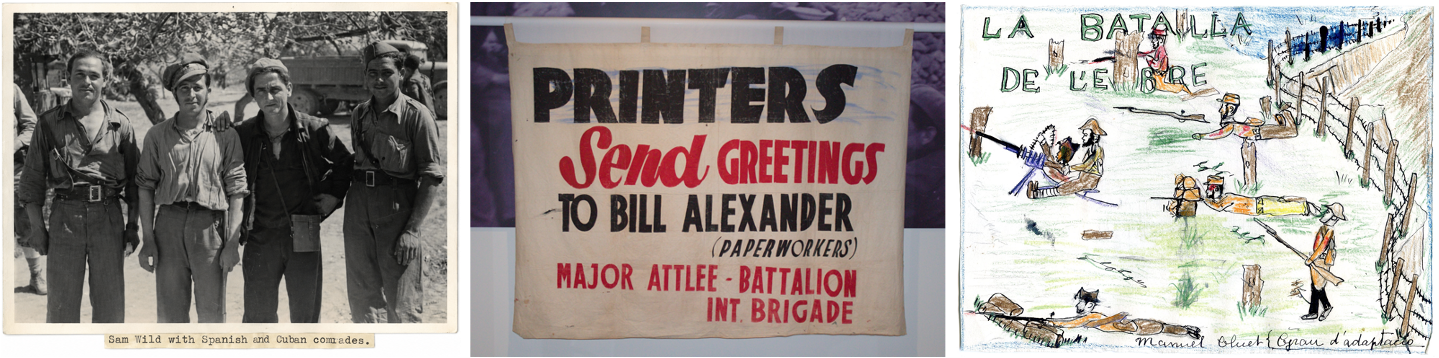
Among the 2,500 volunteers who travelled from Britain to defend the Spanish Republic was Sam Wild (1908-1983), who was born in Ardwick, Manchester and worked as a labourer all his life. Images documenting his experiences in Spain are among those held in the archive at PHM. Reflecting on his decision to volunteer, Wild later recalled, “I came to the conclusion that fascism was determined to conquer the world and it was about time someone started doing something about it.”
The conflict also drew prominent writers, journalists and intellectuals, including George Orwell, whose experiences in Spain would later influence some of his most well-known works. A letter written by Orwell is among the items visitors can see in PHM’s galleries.
PHM’s collections also reveal the wider movement of solidarity that developed across Britain. Trade unions organised support for their Spanish counterparts, which the Printers Send Greetings to Bill Alexander banner (around 1937), currently on display, is an example of. And working people raised funds despite widespread economic hardship. Co-operative shops sold milk tokens to support children and older people affected by the war, and vouchers were purchased to help fund Manchester’s ‘Foodship for Spain’. Examples of these efforts can be seen in the galleries.
Visitors can also see drawings created by refugee children who fled Spain during the conflict. More than 4,000 Spanish children were welcomed into Britain, and their artworks depicting the Battle of Ebro provide a powerful record of how young people saw the war. And in the museum’s archives there is further evidence of the huge effort that was put in place – from providing medical supplies to raising funds for the legal representation of those imprisoned.
The Spanish Civil War at 90 – collections & conversation
On Saturday 11 July, PHM is hosting an event in partnership with the International Brigade Memorial Trust and Instituto Cervantes. The event programme will feature talks by historians and authors Chris Hall and Dr Richard Baxell, a film presentation curated by Marshall Mateer, live music from Chorlton-based group The Mad Donnas, and opportunities to view specially selected archive materials from PHM’s collections.
The day offers visitors the chance to remember the people who responded to the crisis in Spain and for those discovering the story for the first time, to learn about the courage, solidarity and international action that continue to resonate 90 years later.
Tickets are priced at £10, with concession (£8.00) and free tickets available. All the booking details are here.
The Spanish Civil War at 90 – family memories
Sam Wild’s experiences during the Spanish Civil War are shared in PHM’s blog, which is written by his grandson Gideon Long and can be read here.
People’s History Museum’s opening hours are 10.00am to 5.00pm, every day except Tuesdays. Gather café is open 10.00am to 5.00pm, every day except Tuesdays, serving hot food until 3.00pm. PHM has a Changing Places toilet and lifts to its galleries. Museum entry is free, with most visitors donating £10. For further information about PHM, its latest programme of events and visiting the museum visit phm.org.uk, and you can keep up to date with the latest news by signing up to receive PHM’s e-newsletter.
ENDS
For further information about PHM, to arrange a visit or interview please contact Fido PR:
laura.sullivan@fidopr.co.uk / clare.short@fidopr.co.uk
Images:
Notes to editors:
About People’s History Museum
People’s History Museum (PHM) in Manchester is the UK’s national museum of democracy, telling the story of its development in Britain: past, present, and future. Through an eclectic and colourful mix of historic and contemporary collections, featuring banners, badges, posters, photography and more, the museum celebrates the radical stories of people coming together to champion ideas worth fighting for.
Offering an engaging programme of exhibitions and events, collaborating with communities to create authentic content, the museum is Family Friendly throughout – inspiring the next generation to be active citizens.
People’s History Museum encourages visitors to be empowered by the past to make a change for the future. We are all together in the fight for a fairer world.
About Arts Council England (ACE)
PHM is an Arts Council England (ACE) National Portfolio Organisation (NPO). The work of PHM is supported using public funding by ACE, the national development agency for creativity and culture. ACE have set out their strategic vision in Let’s Create that by 2030 they want England to be a country in which the creativity of each of us is valued and given the chance to flourish and where every one of us has access to a remarkable range of high quality cultural experiences. From 2023 to 2026 they will invest over £467 million of public money from government and an estimated £250 million from The National Lottery each year to help support the sector and to deliver this vision.
Are you more independent or community focused? Experimental or measured? Prefer work or play?
Take our quick quiz to find out which radical you are!