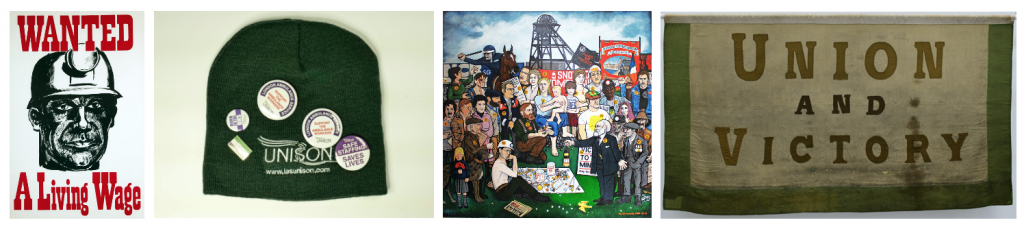
2026 marks the centenary of the General Strike, one of the largest and most significant industrial disputes in British history. Opening at People’s History Museum (PHM) in Manchester on Saturday 21 March 2026 (until 2 November 2026), On The Line explores this historic watershed and takes visitors on a journey that features key strikes and stories of solidarity over the last hundred years.
On The Line examines what drives people to feel that striking is the only option, focusing on historic turning points and the differing perspectives that shape these pivotal moments. Drawing on PHM’s nationally significant collection of historic and contemporary material, the exhibition presents stories of conflict, acts of resistance, and the strength that comes from collective power.
The 1926 General Strike officially lasted only nine days, but its impact was seismic. Between 4 and 12 May 1926, the entire country was brought to a standstill when three million workers withdrew their labour in an unprecedented act of unity called by the Trade Union Congress (TUC). This remarkable expression of national solidarity was in support of more than a million miners who had been locked out of work for refusing to accept lower pay and longer hours. Although the strike was called off without guarantees, leaving the miners to fight on for another seven long months, it remains a defining moment in the history of organised labour. Evocative images in the exhibition capture the tense atmosphere and a series of reportage images by amateur photographer Joe Short (1903-1981) reveal glimpses of everyday life, but also the hardship endured, for example, including images of ‘soup kitchens’ established in colliery villages.
Stories of unity and solidarity run through the entire show. These include the 1972 Miners’ Strike over wages and hours, the Grunwick Strike for union recognition (1976-1978), and the women of Ford Dagenham who took action for equal pay in 1968. Visitors will encounter objects from the frontline of these industrial disputes and photographs from the time. Objects on display include a full-scale Ambulance Strike Shelter, which is from the ambulance workers’ pay dispute of 1989-1990.
Industrial struggle is rarely captured in fine art, but On The Line features two oil paintings going on public display for the first time. Taking Scabs To Work, Barking Hospital by artist S. Rushton, thought to have been painted around 1984, tells the story of a strike that occurred following the privatisation of hospital cleaning services, which resulted in a cut in cleaning hours and impacted workers’ rights. In contrasting style, David Rumsey’s The Past Is Another Country is a vibrant, graphic work depicting key figures and scenes from the Miners’ Strike (1984-1985), including the Battle of Orgreave. Begun in 1984, the piece was a labour of love that took almost 30 years to complete.
These paintings are displayed alongside protest banners from PHM’s collection. These include the oldest object in the exhibition, the Union and Victory banner, which was first seen during the Great Dock Strike of 1889. Many of the banners are artworks in their own right, which is certainly the case with the Grunwick Strike Committee banner. This is one of several objects marking the 50th anniversary of this extraordinary event. Led by Jayaben Desai (1933–2010), a migrant worker from East Africa, the strike saw workers stand up to their managers in a fight for rights and representation, sparking one of the largest mobilisations in labour movement history.
Jayaben’s is one of many powerful examples of worker solidarity featured in the exhibition. Others include Women Against Pit Closures, which began as grassroots groups scattered around the country formed by women and miners’ wives during the Miners’ Strike (1984-1985) and grew into a nationwide movement. They organised essential support to the strikers – fundraising, public speaking, distribution of food, and picketing – and their story is visually represented as the lifeline that it provided through t-shirts, posters, and images.
Historic objects from PHM’s collection are exhibited with some of the most recent objects to be added to its collection. These include the Deceptioncon robot costume (2023-4), which was created to be worn by employees fighting for their right to unionise at Amazon’s Coventry warehouse. The robot symbolised the feelings of workers, who felt that they were being treated like robots.
Clare Barlow, Director of People’s History Museum, says, “Across the 20th century strikes have highlighted real injustices at work: unequal pay, discrimination and a lack of basic human dignity, with workers denied even the right to take bathroom breaks. Strikers have fought for the right to challenge these conditions, and many have stood by them in that struggle. On The Line is an exhibition full of stories of community and solidarity – of the Grunwick workers fighting to unionise in the face of systemic racism, of pensioners giving their pension to support striking miners, of soup kitchens being established, and of donations being collected to keep families fed and clothed. Above all, it’s an exhibition that asks us what we want of work, and what we’d be prepared to fight for.”
On The Line opens at People’s History Museum on Saturday 21 March 2026 (until Monday 2 November 2026) and is part of the General Strike 100 national partnership that includes over 15 museums, libraries, archives, and groups. It is generously funded with support from The TUUT Charitable Trust, GMB Union, and Lesbians and Gays Support the Miners, who have made this exhibition possible.
People’s History Museum’s opening hours are 10.00am to 5.00pm, every day except Tuesdays. Gather café is open 10.00am to 5.00pm, every day except Tuesdays, serving hot food until 3.00pm. PHM has a Changing Places toilet and lifts to its galleries. Museum entry is free, with most visitors donating £10. For further information about PHM, its latest programme of events and visiting the museum visit phm.org.uk, and you can keep up to date with the latest news by signing up to receive PHM’s e-newsletter.
ENDS
For further information about PHM, to arrange a visit or interview please contact Fido PR: laura.sullivan@fidopr.co.uk / clare.short@fidopr.co.uk
Notes to editors:
About People’s History Museum
People’s History Museum (PHM) in Manchester is the UK’s national museum of democracy, telling the story of its development in Britain: past, present, and future. Through an eclectic and colourful mix of historic and contemporary collections, featuring banners, badges, posters, photography and more, the museum celebrates the radical stories of people coming together to champion ideas worth fighting for.
Offering an engaging programme of exhibitions and events, collaborating with communities to create authentic content, the museum is Family Friendly throughout – inspiring the next generation to be active citizens.
People’s History Museum encourages visitors to be empowered by the past to make a change for the future. We are all together in the fight for a fairer world.
About Arts Council England (ACE)
PHM is an Arts Council England (ACE) National Portfolio Organisation (NPO). The work of PHM is supported using public funding by ACE, the national development agency for creativity and culture. ACE have set out their strategic vision in Let’s Create that by 2030 they want England to be a country in which the creativity of each of us is valued and given the chance to flourish and where every one of us has access to a remarkable range of high quality cultural experiences. From 2023 to 2026 they will invest over £467 million of public money from government and an estimated £250 million from The National Lottery each year to help support the sector and to deliver this vision.

About The TUUT Charitable Trust
The TUUT Charitable Trust was established by the trade union movement in 1969. The Trust aims to support the most vulnerable in society through donations to registered charities.
www.tufm.co.uk/about-us/charity
About GMB Union
GMB is an organising and campaigning union for all workers, currently numbering some 500,000 members. Founded in 1889, it has a long and proud history that stretches through the General Strike of 1926 to the Grunwick Dispute, of 1976-78, and the recent Glasgow Women’s Strike, of October 2018, which secured gender equality for thousands of women across the city, transforming lives and opportunities.
www.gmb.org.uk
About Lesbian and Gays Support the Miners (LGSM)
The London Lesbians and Gays Support the Miners (LGSM) group was formed in July 1984, four months into the year-long miners’ strike of 1984-5. Founding members Mike Jackson and Mark Ashton had organised a bucket collection to support the striking miners on the June 1984 London Pride march and decided that more needed to be done to raise awareness of the miners’ cause in the London lesbian and gay community.
www.lgsm.org
Are you more independent or community focused? Experimental or measured? Prefer work or play?
Take our quick quiz to find out which radical you are!