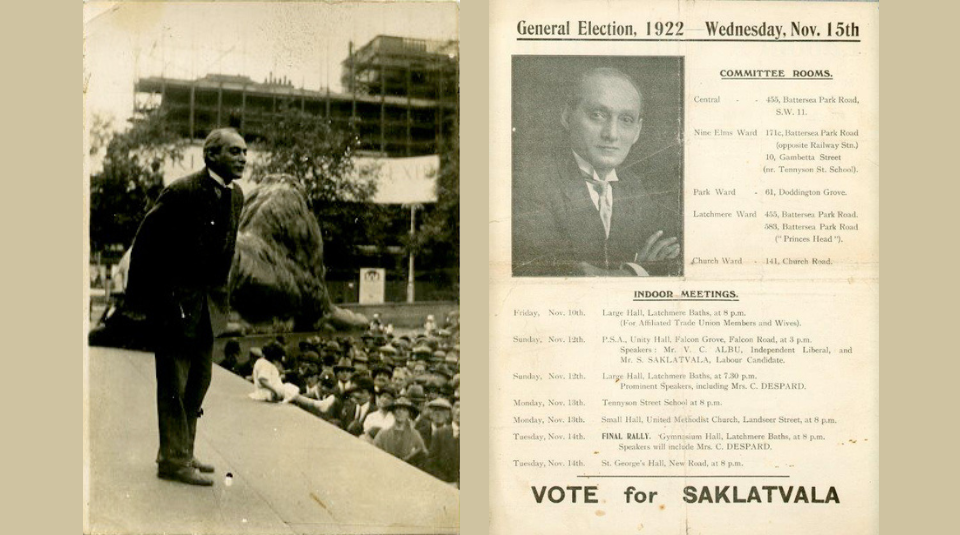
In 1926, on the eve of the General Strike, Shapurji Saklatvala MP called on soldiers not to shoot their fellow workers. He was arrested on charges of sedition, his trial was rushed through, and he was imprisoned until the strike was officially over.
In the final of a series of three blogs exploring the 1926 General Strike, Dr Dan Edmonds, PHM and Royal Holloway University of London researcher, tells us more about Saklatvala, 100 years after his release from prison.
Born in Mumbai in 1874, Shapurji Saklatvala was the nephew of J N Tata, one of the wealthiest men in India, and had a job in the family firm. The family had an office in Manchester, where Saklatvala moved to in 1905 – ostensibly due to ill health, but also as his family feared his growing political interests could cause trouble.
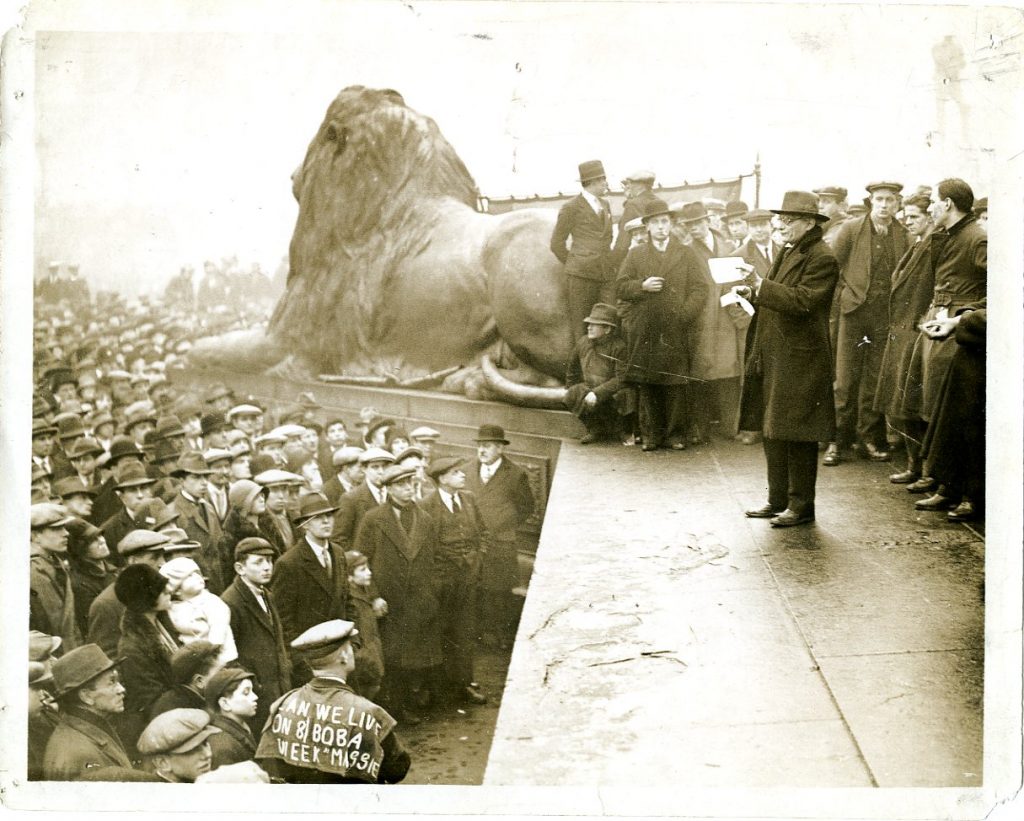
In England Saklatvala joined the Independent Labour Party (ILP) in 1909, drawn to ideas of equality and socialism. He had intended to return to India, but in Matlock, Derbyshire, he met a waitress, Sarah Marsh, and their marriage and children kept him in England. In 1917 the Russian Revolution shook the world. In Britain the impact of the Revolution was described by the Prime Minister, Lloyd George, as a ‘new infection’ which ‘encouraged all the habitual malcontents in the ranks of labour to foment discord and organise discontent’. Saklatvala, embedded now in ILP networks, was one of these malcontents hugely inspired by events in Russia.
In 1919 the Communist International was formed and Saklatvala, like many others in the ILP, worked hard for his organisation to affiliate. He was not successful, however, and in 1921 he left the ILP. He was now a member of the Communist Party of Great Britain (CPGB), but he was also a member of the Labour Party; the two organisations were not yet in direct opposition.
Saklatvala’s anti-colonialism and indignity at poverty drew him to revolutionary socialist ideas. A fiery orator, Saklatvala first caught the attention of the authorities during the First World War. Establishment figures feared that he could link militant sections of the labour movement with Indian nationalists, Sinn Féin, and the Russian Bolsheviks.
Saklatvala’s story ties into important historical concepts as well. Historical sociologist Professor Satnam Virdee in his book ‘Racism, Class and the Racialized Outsider’ (2014) talks of how radical ‘racialised outsiders’ often posed a unique threat to the state. Their experience of inequality and repression often made their struggles more avowedly political. Their involvement in protest movements ‘acted as a leavening agent nourishing the struggles of all, informed by their unique perspective on society.’
In 1920 the Metropolitan Police and the Security Service had given serious thought to arresting him. The previous two years had seen unrest on a scale that terrified the authorities. Strikes were common, riots frequent, and even mutinies were taking place, all while India, Ireland, and Egypt saw nationalist movements arise to challenge the British Empire.
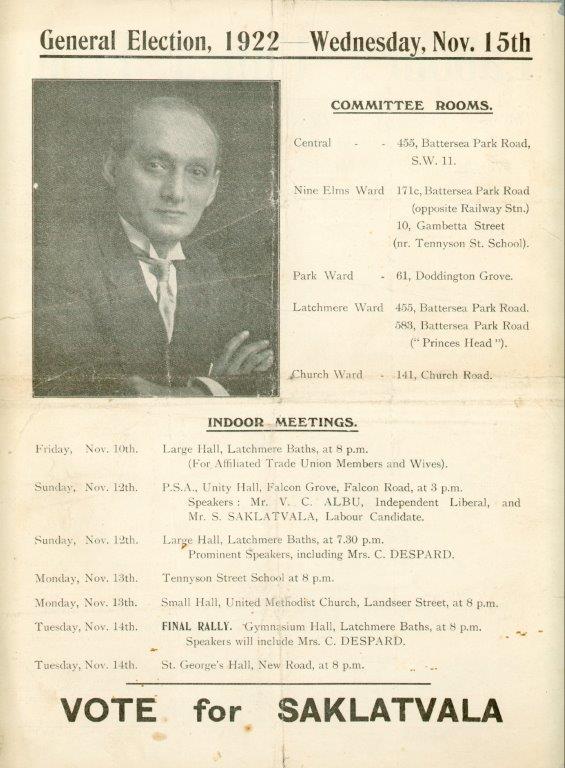
Saklatvala’s threat to imperial order was too much to ignore. Now considered by the authorities the most dangerous man in Britain, he was watched at various times by MI5, the Home Office, Indian Political Intelligence, and Special Branch. His letters were opened, his house was raided, and he was denied entry to the United States, Egypt, and eventually India – the land of his birth. Fortunately for Saklatvala nothing was found to justify his imprisonment. He would become well known in Battersea, south west London, and was selected as Battersea North’s Labour candidate for parliament, despite being a member of the Communist Party of Great Britain (CPGB). In 1922 he entered the House of Commons as the first Labour MP from the global majority.
When Prime Minister Lloyd George declared Britain’s army could be used in the Russo-Polish war against the Soviets in August 1920, the Labour Party set up ‘Councils of Action’ across the country, threatening a general strike if Britain intervened. Saklatvala encouraged these councils to use their power to challenge British treatment of Indians and the potential use of Indian soldiers against Russia. He was not successful, but the British army weren’t mobilised against Russia.
Official fears about Saklatvala rose again after ‘Red Friday’ in July 1925 – when railway unions threatened to join the miners on strike if their pay was cut. The government granted a nine month subsidy to the mining industry, but the countdown to a general strike was on, and to many in Prime Minister Stanley Baldwin’s government this was potentially a revolutionary threat.
Saklatvala thought this was about more than wages, and that the General Strike could potentially see very serious conflict. In his speeches through 1925 and early 1926 he called on trade unionists to make every effort to win over working class soldiers, and to refuse to repress them. His language was carefully chosen, and he avoided arrest despite police requests to the Home Secretary.
“If you want peace, if you mean peace, if you sincerely want to work for peace… then go to those who are misled by this system, and armed to the teeth to destroy and kill. What is the good of propaganda of peace amongst unarmed workers, let us go to those armed boys, who are kept ready to fight and kill, and tell them not to shoot the working class.”
Saklatvala’s speech in Coventry to the Minority Movement conference (Source: National Archives. HO 144/6099).
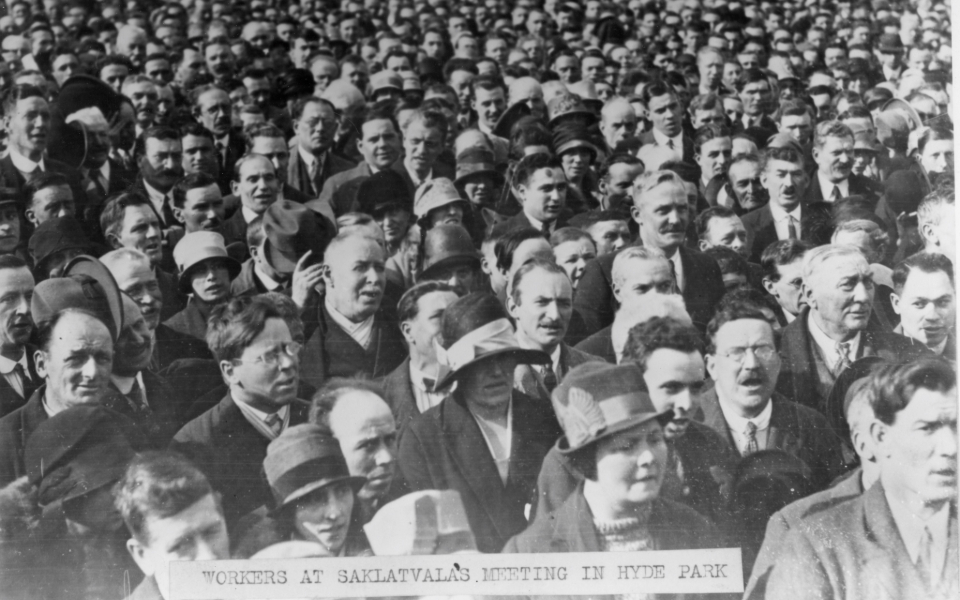
However when Saklatvala made a similar speech at Hyde Park on 1 May 1926, the Trades Union Congress (TUC) had announced their intention to launch a general strike, and the government had declared a State of Emergency. The Extraordinary Powers Act (passed in the tumult of 1920) allowed the government to treat any remarks that could incite people as a seditious offence during this situation. He was arrested the following day and imprisoned for the next two months.
Saklatvala’s arrest caused uproar. Noah Ablett, a miners’ leader, was arrested for threatening to repeat Saklatvala’s words. Communists were arrested for distributing ‘The Young Striker’, a homemade newsletter which carried part of his speech. Leftwing MP George Lansbury challenged the government at a large rally, leading an assembled crowd of thousands to repeat the slogans that had seen Saklatvala and other Communists arrested.
Saklatvala’s activities in the lead up to his arrest, as well as the legislation used to arrest him, help to understand the dynamics of the 1926 General Strike. Saklatvala’s case shows how radical ideals about anti-colonialism, communism, and social equality could motivate leaders and rank and file alike. His arrest shows how the impact of governmental action could work both to dampen and enflame further protests.
Saklatvala was released on 25 June 1926, after the General Strike was officially over, but while the miners’ lockout continued. He rushed straight from prison to the House of Commons to speak in favour of the miners during the day’s debate:
“I hope the House will pardon me for any slips on this occasion, because I have only just returned to this House from a semi-Socialistic institution in which I have been taken care of on a much better scale than the poor miners.”
Saklatvala may have served the 1926 General Strike in prison, but he cast a wide shadow over events, inspiring workers’ participation and government repression in equal measure.
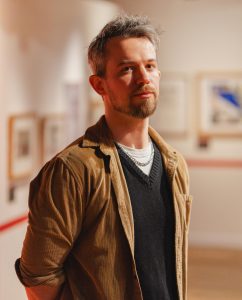
Dan Edmonds is a Royal Holloway University of London (RHUL) researcher working on an Arts and Humanities Research Council funded project, Inclusive Histories. Dan is researching campaigns and activism using the collections of People’s History Museum and the Working Class Movement Library, with learning resources and case studies being developed that can be used to teach a more inclusive British political history GCSE that centres marginalised voices.
Book an appointment to discover more of the collection with the Archive Team via archive@phm.org.uk. Check out the 1926 General Strike archive guide.
Visit the museum’s headline exhibition for 2026, On The Line: 100 years of strikes & solidarity and journey through a century of struggles and stories of strength. On show until 2 November.
Read the first two blogs in this trio, and discover the story of the workers who derailed the Flying Scotsman, and of Marion Phillips and the women who sustained the miners’ lockout.
Sign up to our e-newsletter and be the first to hear the latest from PHM.
Subscribe to @apeopleshistory Substack – sharing stories of struggles for rights and representation, with a particular focus on the History GCSE module, Britain: Power and the People c1170 to the present day.

Are you more independent or community focused? Experimental or measured? Prefer work or play?
Take our quick quiz to find out which radical you are!