Notoriety in your nineties is somewhat of a rarity, but something that campaigner Harry Leslie Smith (1923-2018) reinvented when he was given the title of ‘the world’s oldest rebel’. Ahead of Harry’s iconic jacket going on public display for the first time from Saturday 16 January 2027, we revisit this blog exploring his life and times.
Driven by a desire to see a fairer world for all, Harry was a radical campaigner and activist whose legacy fittingly lives on at People’s History Museum (PHM), alongside those of others who fought for change. He used his life experiences and insight to try and inspire a better future for others and in doing so had an optimistic and hopeful outlook.
In this blog from 2023, former PHM Collections Manager Sam Jenkins took a look at Harry’s story to mark the centenary of his birth (25 February 1923).

In Barnsley, where one of his earliest memories was of the death from tuberculosis (TB) of his elder sister Marion when Harry was just three. Although this was at a time before the foundation of the National Health Service (NHS), TB was treatable for families who could afford medical care. Such was the family’s poverty that Marion was treated and died in a workhouse infirmary and buried in an unmarked pauper’s grave.
Working life began at a young age and by 16 Harry was manager of a Halifax grocery store. In 1941 he joined the Royal Air Force and was posted in Belgium, the Netherlands, and finally Germany where he would meet his wife Friede who was from Hamburg. As a result of the defeat of the Labour government in 1951 and the prejudice and some racism Friede faced as a German citizen living in England, the young couple moved to Canada in 1953.
It was following the death of Friede in 1999 and a decade later with his youngest son, John, that Harry began writing and became the author and activist whose legacy lives on today. In 2008, carrying his own grief and against the backdrop of the financial crisis, he said, “I needed to let people know that the economic and political storms coming our way, I’d seen them before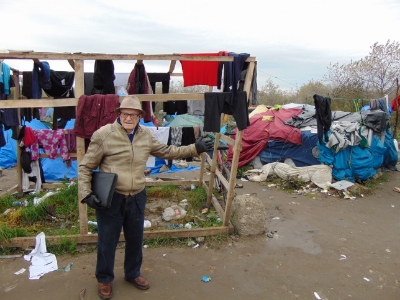
Having lived through the Great Depression and served during the Second World War, Harry saw first hand the lessons that could be learnt, the “preventable tragedies”, the power of humanity and the things that he thought we should all treasure. He shared what his experiences had shown him in his writing and in his speeches. An example is when he spoke about the value of the NHS at the Labour Party conference in 2014 – this was all the more powerful because he was able to recall a time when public healthcare didn’t exist and “No one in our community was safe from poor health, sickness and disease”. In his ‘Guardian’ video essay on the refugee crisis, which he made in 2016 and has been viewed more than 2 million times, he recollects witnessing refugees in their thousands fleeing the Holocaust and the efforts that followed to resettle them compared to the situation he found when he visited the refugee camps of Calais in 2016.
Writing in 2018, just months before he died, he said, ‘I have almost a hundred years of lived history pulsing through my blood and memories. So when I tell you that this is the best of times for the one per cent and the worst of times for everyone else, heed my words.’ Harry’s last stand was to try and achieve a fairer society for all, which makes him a radical hero in the eyes of so many.

When Harry passed away in 2018, there was an outpouring of grief from people who had been inspired by him. It was fitting to represent the ‘world’s oldest rebel’ (a moniker attached to Harry by the Broadbent Institute, Canada’s leading progressive policy organisation, and subsequently picked up by the media) in a collection dedicated to democracy, justice, and the fight for a better world.
Beginning in 2019 PHM explored migration through a huge programme of activity which asked visitors to rethink what they knew about migration. That same year Harry’s son John donated the leather jacket; an evocative piece to bring that personal connection to PHM’s collection for the future. Worn during Harry’s campaigns to help refugees and shed light on the conditions many were facing, the jacket became an iconic piece of attire that you’ll see him wearing in many of the press images taken at the time.
It’s a jacket that carries a story and that represents Harry Leslie Smith as an author and activist, someone who took a stand and made a difference.

Read ‘Harry’s Last Stand: How the World My Generation Built is Falling Down, and What We Can Do to Save it’ (2014) and ‘Don’t Let My Past Be Your Future: A Call to Arms’ (2017).
Highlighting the ongoing support needed for refugees around the world, joint winners of the recent series of BBC’s ‘The Celebrity Traitors’ both chose to donate their prize winnings to refugee charities; actor Sebastian Croft to Choose Love, and comedian Romesh Ranganathan to Refugee Council.
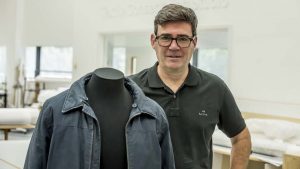

When Harry gave his NHS speech in 2014 it was followed by a speech from Andy Burnham who was then Shadow Health Secretary. Andy’s dark navy workers’ jacket, which he wore as Mayor of Greater Manchester during the Covid-19 speeches he made on behalf of the region in 2020, is also part of the collection at PHM.

Migration: a human story is the culmination of PHM’s migration project spanning 2019 to 2022, including a series of creative interventions designed in collaboration with a Community Programme Team and installed throughout the galleries, asking visitors to rethink what they know about migration. With support from Art Fund and The Joseph Roundtree Charitable Trust.
An earlier version of this blog was published on 25 February 2023.
Are you more independent or community focused? Experimental or measured? Prefer work or play?
Take our quick quiz to find out which radical you are!