The archive at People’s History Museum (PHM) contains wide-ranging materials directly related to socialist feminism in the UK. These include a complete run of the feminist magazine Red Rag alongside related periodicals such as Women Today and Tomorrow, Marxism Today and, The Link.
We caught up with University of Manchester student Amy Todd, who has created a new Socialist Feminism study guide for PHM’s archive whilst working at the museum and conducting research for her PhD.
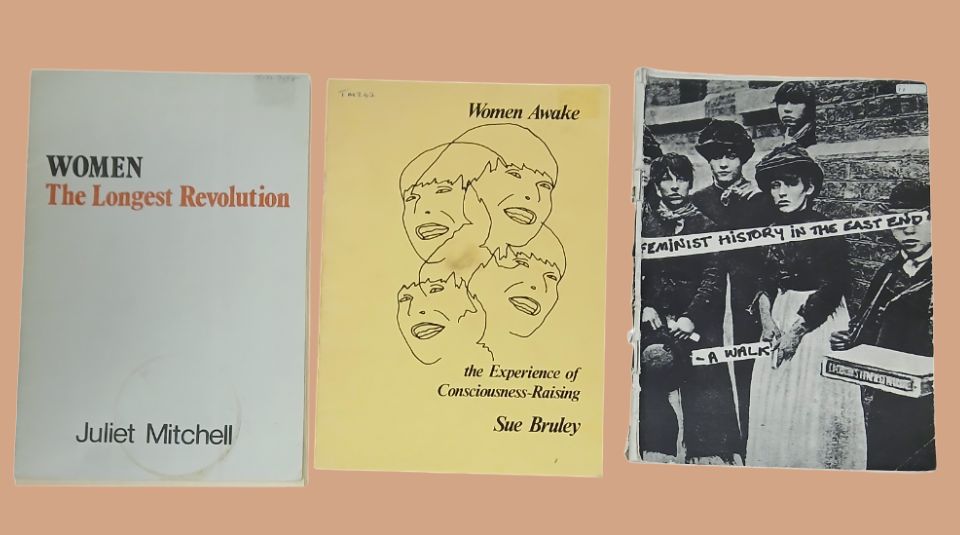
We asked Amy about the history of the Socialist Feminism Movement in a conversation illustrated by examples of feminist print culture from the museum’s rich collection.
Socialist feminism in the UK has a history dating back to the often referenced ‘first wave’ of feminism (1920-1948). Borne from the ideologies of feminism and Marxism, both with their histories dating back hundreds of years, socialist feminism usually refers to a faction of the Women’s Liberation Movement (WLM) in the UK (1969-1989).
The Women’s Liberation Movement in the UK had a unique genealogy, distinct from the movement in the US, which derived from women from institutions, organisations, and groups of the British leftwing. Socialist feminism in the UK emerged as a powerful force for liberation, not just for women, but for the broader population. It was shaped by the lessons, tools, organisational structures, and ideologies drawn from a range of groups. These include the Communist Party of Great Britain (CPGB), Trotskyist organisations like the International Marxist Group and the International Socialists (later the Socialist Workers Party), and trade unions (even in defiance of them at times). This development took place alongside a radical wave of international civil unrest from 1968, which united students, workers, gay rights activists, civil rights campaigners, reproductive rights advocates, and movements against war, nuclear weapons, and colonialism.
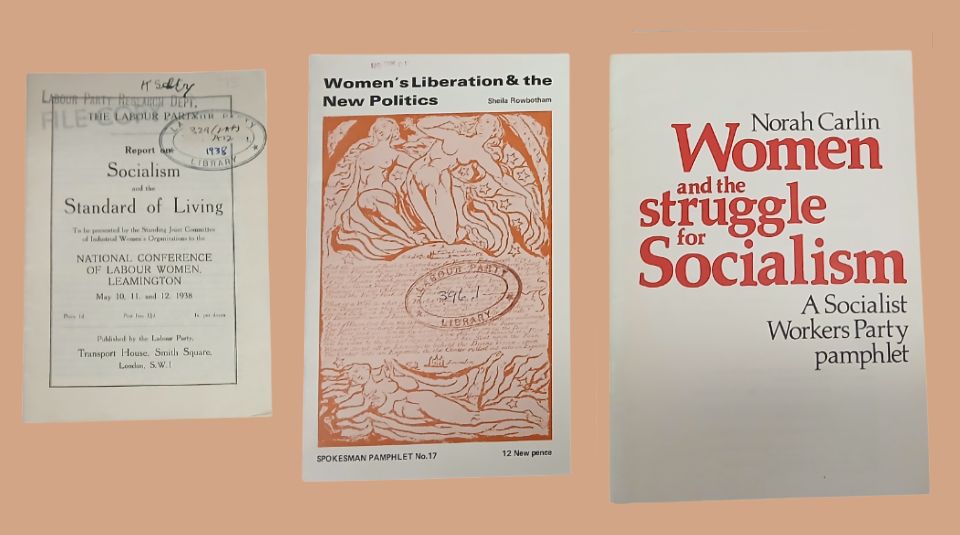
Socialist feminism was formative to the creation and development of the Women’s Liberation Movement . Many socialist feminist women led the way in the creation of print culture, including the magazines Red Rag[1], Spare Rib,[2] and Scarlet Women[3]. They also played key roles in organising the national WLM conferences, including women such as Roberta Hunter-Henderson (1945-), Sally Alexander, Rosalind Delmar (1941-2019) Sheila Rowbotham (1943-), Lynne Segal (1944-), and Anna Davin (1940-). Publications that saw the creation of new fields of knowledge are also part of the creative output of socialist feminists of the time – with works such as Beyond the Fragments (1979)[4], Hidden From History (1973)[5] and Women and the Subversion of Community (1975)[6] – all being written directly from by feminists reflecting on ‘the woman question’ within socialism.
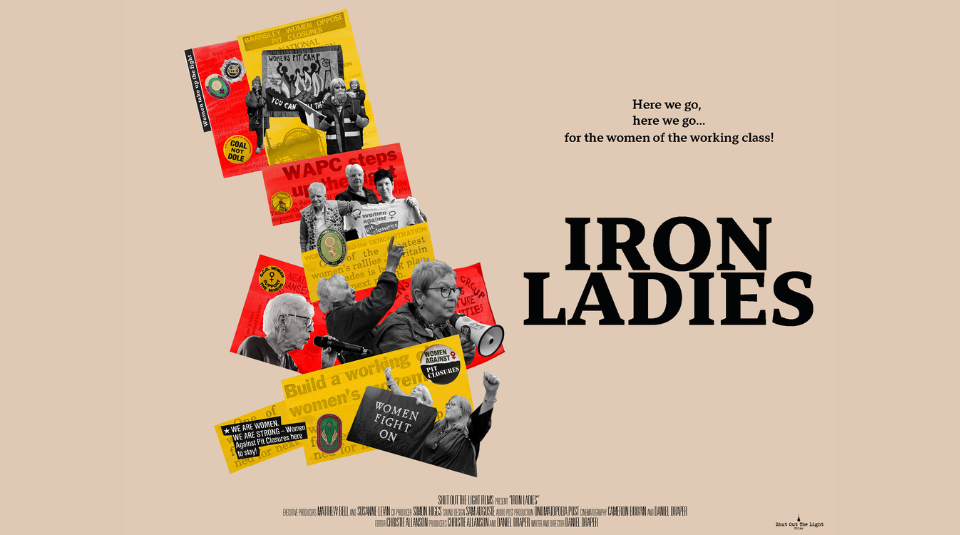
Women like the CPGB’s Nell Myers and Jean McCrindle (1937-2022) were crucial to extending the socialist feminist activism of the 1970s into the 1980s and brought their skills and experience to the 1984 to1985 Miners’ Strike through the editing of the National Union of Miner’s (NUM) newspaper, The Miner, and organising and mobilising support for the strikers with Women Against Pit Closures.
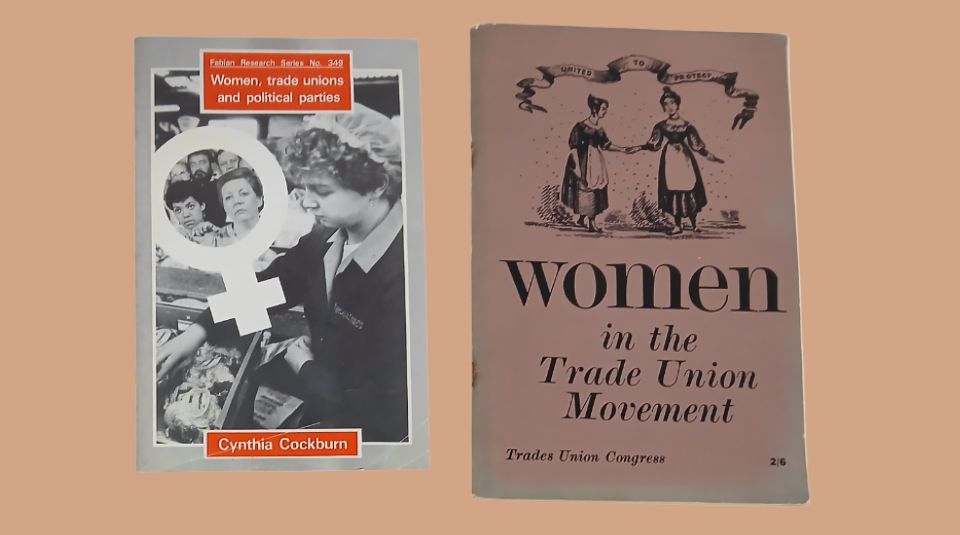
Socialist feminist activism in the UK thrived through both formal and informal networks that bridged local, national, and international struggles. These networks were not limited to one political party or faction but spanned a broad ideological spectrum on the left. They facilitated collaboration among feminist groups, political and subcultural publications, trade unions, radical bookshops, women’s centres, political parties, community centres, and academic institutions, enabling ideas and actions to circulate widely.
Groups and campaigns associated with the socialist feminist activity of the Women’s Liberation Movement period (1968-1988) are illustrative of the ‘personal is political’ ethos of the women’s movement, while also demonstrating how these actions, campaigns, debates, and theories contributed to a socialist liberation that centred on women’s needs, which was increasingly at risk to governmental reforms as the decade unfolded. These campaigns can be seen through the work of the National Abortion Campaign[7], the activism of the Women Against Pit Closures group during the Miners’ Strike (1984-1985)[8], the Wages for Housework campaign [9], The Communist Party of Great Britain led Working Women’s Charter[10], Claimant’s Unions[11] and trade union disputes such as the Night Cleaner’s campaign led May Hobbs (1938-)[12], and the Grunwick strike (1976-1978) led by Jayaben Desai (1933-2010) [13] – as spaces where socialist feminist principles were actively put into practice.
Radical and feminist print culture played a vital role in sustaining these networks. Publications such as Spare Rib, Scarlet Women, and Red Rag functioned not just as magazines, but as platforms for debate, orgorganisation, and now as archives of political memory and feeling. They reflected the movement’s ongoing negotiations with race, class, labour, sexuality, and gender, making space for intersectional critiques and laying the groundwork for later influential intersectional work such as Tithi Bhattacharya’s Social Reproduction: Re-mapping Class, Re-centering Oppression[14].
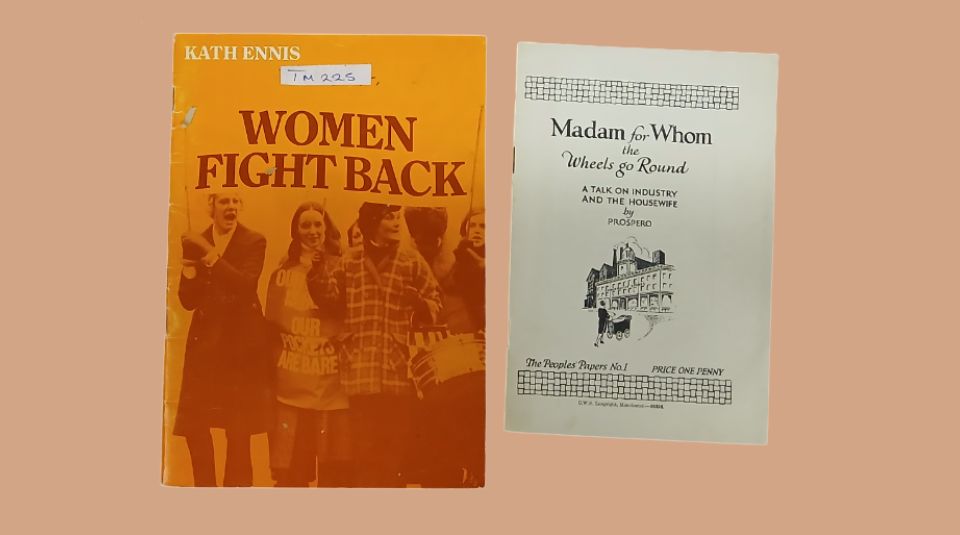
PHM’s archives hold many documents that trace these networks and their impact – from meeting minutes and posters, to personal correspondence and campaign leaflets – preserving the lively network of socialist feminist organising of the period. The Labour History Archive & Study Centre (the archive) at People’s History Museum contains vast and diverse materials directly related to socialist feminism in the UK in the 20th century. It also includes materials that can illuminate aspects of socialist feminism and add critical context to this subject, such as the archives of the Labour Party [15] and the CPGB [16], and the personal papers and collections from people such as Salme Pekkala-Dutt (1888-1964)[17], Hilary Wainwright (1949-)[18] and Ellen Wilkinson (1891-1947)[19]. The collections are strongest when covering socialist feminism in the UK from the 1960s to the 1980s, as opposed to earlier or later, particularly alongside the Women’s Liberation Movement. For example, the Feminist Webs collections contain the libraries and research materials of north west based feminist socialist activists and therefore include key feminist socialist texts and ephemera from the 1960s to the 1980s.

Amy Todd is working at PHM helping researchers visiting the archive to explore our incredible collection of political archive material whilst studying for a PhD at The University of Manchester.
Her research focuses on the Women’s Liberation Movement in Britain (1968-1988) and the magazines that were created by women involved in this political movement.
The museum’s internationally significant collection includes items of national importance from the last 250 years of British social and political history.
It is home to the complete holdings of the national Labour Party and Communist Party of Great Britain and over 95,000 photographs relating to the growth of democracy in Britain, covering not only parliamentary reform, extension of the vote and general elections, but grassroots organisations and campaigns also.

View the Socialist Feminism archive guide and use PHM’s handy research guides to learn more about other archive collections. The archive is open to researchers every Wednesday to Friday, 10.00am to 4.00pm, lunchtime closure 12.30pm to 1.30pm.
Read a previous blog by Amy Todd, which is one of a series of three exploring miners’ strikes. Amy explores the Women’s Movement Against Pit Closures during the 1984 to 1985 Miners’ Strike.
Join Amy when she hosts a screening and Q&A of Iron Ladies, a film dedicated to the iron-willed women who fought for the future of their communities on Saturday 28 March. This is part of the accompanying programme to the On The Line: 100 years of strikes & solidarity exhibition (21 March to 1 November 2026) at PHM, to mark the centenary of the 1926 General Strike and examine its legacy. Get your tickets.
[1] Reference for the Labour History Archives & Study Centre: CP/CENT/WOM/5/8
[2] Available at the Working Class Movement Library, Salford.
[3] Reference for the Labour History Archives & Study Centre: (uncatalogued) Feminist Webs; Boxes 16a, 21a and 21d.
[4] Rowbotham, Sheila, Segal, Lynne and Wainwright, Hilary, Beyond the Fragments: Feminism and the Making of Socialism, 1st commercial edn. (London: Merlin Press, 1980)
[5] Rowbotham, Sheila, Hidden from History: 300 Years of Women’s Oppression and the Fight Against It, 1st edn. (London: Pluto Press, 1973)
[6] Dalla Costa, Mariarosa and James, Selma, Women and the Subversion of the Community, 1st edn. (Bristol: Falling Wall Press, March 1972).
[7] Whose campaigns can be followed in Spare Rib (available at the Working Class Movement Library, Salford), Scarlet Women, WIRES and Shrew. Reference for the Labour History Archive & Study Centre(uncatalogued) Feminist Webs; Boxes 16a, 21a and 21d and Red Rag: CP/CENT/WOM/5/8
[8] See; Martin Walker’s papers: GB 394 MS84/MW/6/3 and The Papers of Hilary Wainwright (1949-) 1960s-1980s: GB 394 WAIN
[9] Dalla Costa, Mariarosa and James, Selma, Women and the Subversion of the Community, 1st edn. (Bristol: Falling Wall Press, March 1972).
[10] See; Papers of the Working Women’s Charter Campaign, 1950-1989. CP/CENT/WOM/5/7
[11] Reference for the Labour History Archive & Study Centre: (uncatalogued) Feminist Webs; Boxes 16a, 21a and 21d.
[12] See: Red Rag: CP/CENT/WOM/5/8
[13] See: Red Rag: CP/CENT/WOM/5/8
[14] Bhattacharya, Tithi (ed.), Social Reproduction Theory: Remapping Class, Recentering Oppression (London: Pluto Press, 2017).
[15] Particularly: Labour Party Chief Woman Officers’ Papers 1916-1995. Reference for the Labour History Archive & Study Centre: B 394 CWO
[16] Particularly: Reference for the Labour History Archive & Study Centre: CP/CENT/WOM
[17] Reference for the Labour History Archive & Study Centre: CP/IND/DUTT
[18] The Papers of Hilary Wainwright (1949-) 1960s-1980s. Reference for the Labour History Archive & Study Centre: GB 394 WAIN (there is also a currently uncatalogued collection of here further papers to be made publicly available soon).
[19] Ellen Wilkinson Papers (1924-1947) Reference for the Labour History Archive & Study Centre: GB 394 WI

Are you more independent or community focused? Experimental or measured? Prefer work or play?
Take our quick quiz to find out which radical you are!